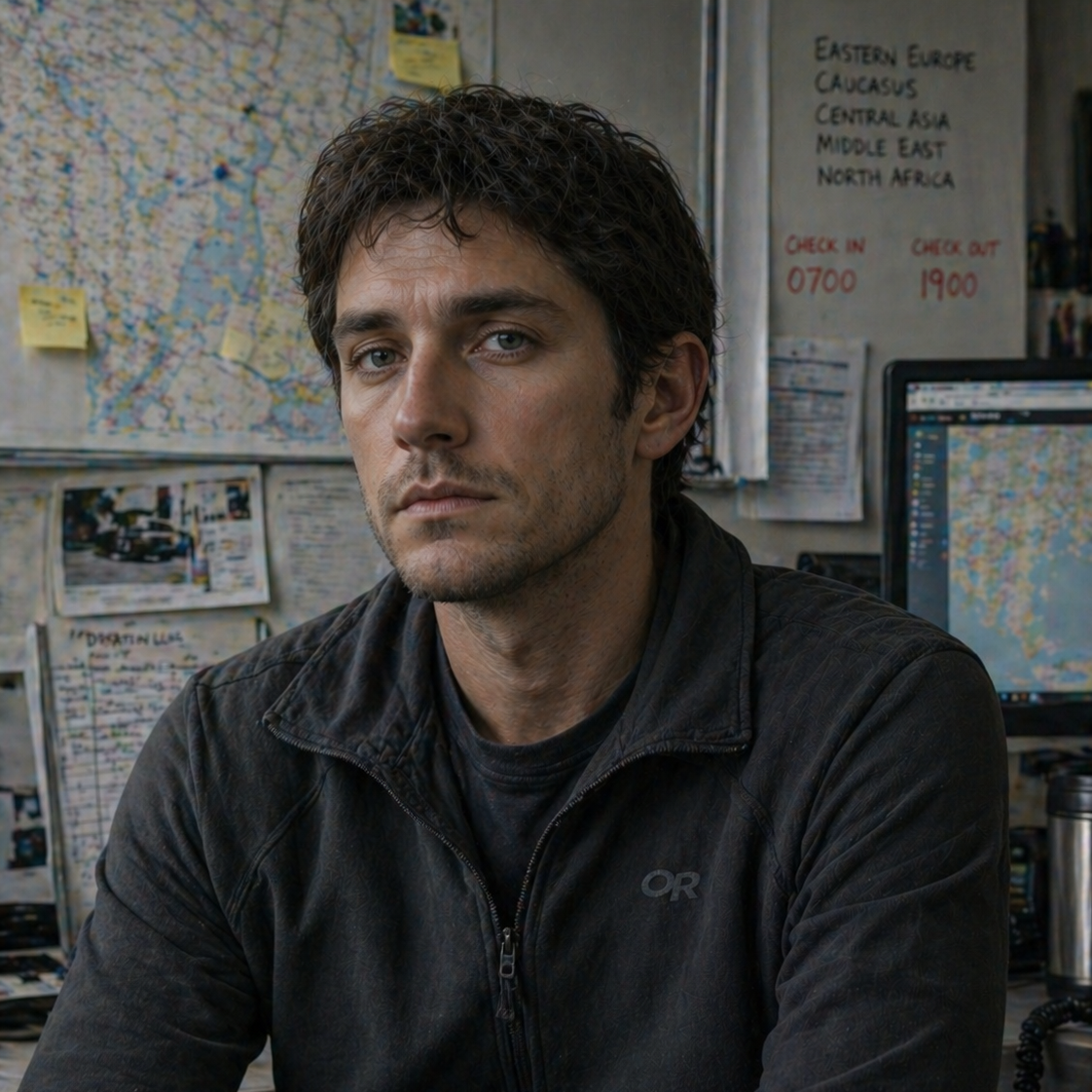
Dispatches
Dispatch from northern Mexico: on the silence of Chuy
The correspondent's inaugural dispatch for It's Not a Simulation, filed from a region he has agreed, as a condition of the reporting, not to name.
By Colson Farragut — April 24, 2026
The correspondent's inaugural dispatch for It's Not a Simulation, filed from a region he has agreed, as a condition of the reporting, not to name.
by colson farragut
The driver — whose name I agreed, as a condition of the reporting, not to use, and who I will refer to here as "Chuy," though that is not his name, and whose trust I earned over the course of a fourteen-minute drive from the airport — told me, without prompting, that he did not know what I was doing in his country.
"I'm a journalist," I said.
He looked at me in the rearview. "Why?"
It is a question I have been asked before, in my work, and it is always the question beneath the question. Why, in a country like this one, would a man like me come to a place like this. I wanted to tell him about the piece. About the networks I had come to document. About the way the northern corridors have become, in the last eighteen months, something that my profession has failed to see clearly. I wanted to tell him about the editor in Brooklyn who had told me, at the bar where we meet, that there was a story here that nobody else would touch. I wanted to tell him I was afraid.
Instead, I said: "I write things."
He nodded, slowly, and turned up the radio. The song was in Spanish. I do not speak Spanish well, but I speak it well enough to understand that the song was about a woman. He did not speak for the rest of the drive. The silence, I would come to realize, was the first thing he had told me.
The hotel was a Holiday Inn Express.
I had booked it under a name that was not my own — a precaution suggested by the editor, which I had questioned, and which Chuy, who had seen the name on the reservation, did not question. The clerk at the desk did not ask for identification. The clerk smiled. The clerk handed me a key and a paper receipt. On the receipt was my real name. I did not correct this. I folded the receipt and put it in my wallet. The lobby was playing a song I recognized from a gym I used to go to in Brooklyn.
I did not sleep well.
In the morning, at the hotel's complimentary breakfast, I observed three men at a corner table. They were eating eggs. They were speaking in voices that were, I believed, deliberately quiet. They glanced at me twice during the approximately fourteen minutes I was in the breakfast area. I did not glance back, except to confirm, through the reflection of a decorative mirror, that the glances had occurred. I have been in rooms with men like these before. I have learned, in my work, to assess without being seen to assess. The three men finished their eggs at approximately 7:45 and left the breakfast area. The tallest of the three made eye contact with me as he left. I held the eye contact for what I judged to be the appropriate duration — long enough to register that I had seen him, short enough to communicate that I was not a threat. The tallest of the three nodded at me.
I understand, now, what that nod meant.
The meeting I had come for was at 10 a.m., at a location I had been given only the morning I arrived. Chuy was to drive me. He arrived at the hotel at 9:35. He did not speak during the drive, which lasted approximately twenty-two minutes and took us through a part of the city I had not seen from the air. The buildings were lower. The traffic was less. At the end of a street that I would not, in any subsequent piece, be able to name, Chuy pulled the car to the side and stopped.
"Here," he said.
"Here" was a convenience store. A man was standing outside the convenience store, smoking. The man was, I understood immediately, not the man I was meant to meet. The man was wearing what I would come to understand was the uniform of a certain kind of middle-management figure in the economy I had come to document. I stepped out of the car. I approached the man. I introduced myself using the name I had been given to use, which was not my name. The man looked at me for what I believe was eight seconds. He then said, in English with a Midwestern accent that I had not anticipated, "You're at the wrong store."
He provided me with an address. He did not say anything else. I returned to the car. Chuy, who had not moved, said, "Okay?"
"Wrong store," I said.
Chuy did not respond to this. Chuy put the car in gear. We drove to the address I had been given, which was another convenience store, approximately six blocks away. At this convenience store, a different man was waiting. This man was wearing different clothes and spoke different English. I will not describe the conversation we had inside the second convenience store, because the substance of that conversation is the substance of this piece, and the substance of this piece requires more space than the remainder of this dispatch will allow. I will return to the second convenience store in my next filing.
What I will say here is this.
I spent four days in the city I am not naming. I spoke with seven people whose names I am not printing. I drank coffee in three cafés. I ate, on one occasion, an excellent fish. I saw, from the window of my hotel room on the third night, something in the street below that I am still, two weeks later, turning over in my mind — not for its drama, which was limited, but for the way it revealed, to a man whose work has brought him to places like this before, something about the difference between what one expects to see and what one actually sees. I believe, though I cannot confirm, that Chuy knew about the thing in the street. I did not ask him.
On my last morning, at the same breakfast area, the three men from the first morning were eating eggs at the same corner table. The tallest of the three nodded at me. I nodded back. This time I understood the nod.
The man I had been sent to meet did not, in the end, agree to be quoted. He declined, as I would come to realize, with a certain professional courtesy. He offered me coffee. He answered my questions without answering them. He looked at me with what I took, at the time, to be a kind of patience. I understand now that it was not patience. It was something else. I will not, in print, say what.
I flew out of the city on the fifth day. Chuy drove me to the airport. As I got out of the car at the curb, Chuy said, for the first time since the initial drive from the airport, more than one sentence. He said: "Please do not come back."
I have been thinking about this sentence for three weeks.
I do not know, yet, what I will do with what I learned. I am writing this dispatch from the bar where my editor and I meet, in Brooklyn, on a Wednesday afternoon. The editor has ordered a martini. I have ordered a beer. The editor has asked me, three times now, whether I am all right. Each time I have said yes.
I will return to the second convenience store in my next filing.
— Filed from Brooklyn